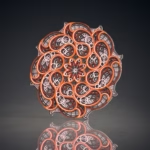
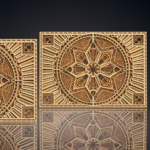

The field of layered laser cutting technology is poised for significant advancements in the coming years. As industries continue to embrace automation, the integration of intelligent systems with laser cutting processes is becoming increasingly prevalent. Automated laser cutting solutions will streamline production workflows, enhance consistency, and reduce human error. This shift towards automation not only improves efficiency but also allows for more complex designs that were previously unattainable.
Moreover, the integration of Computer-Aided Design (CAD) and Computer-Aided Manufacturing (CAM) systems with layered laser cutting technologies will further transform the manufacturing landscape. These systems will enable designers and engineers to push the boundaries of creativity, optimizing laser cutting operations to better meet specific requirements. The synergy between design software and laser cutting machinery will yield a more ubiquitous approach to customization, permitting elevated levels of precision and detail to be achieved in various materials.
Another anticipated trend is the rise of hybrid machines that combine laser cutting with other manufacturing processes. These machines will offer manufacturers the capability to conduct multiple operations, such as welding, engraving, or even 3D printing, in a singular seamless workflow. This integration allows for greater flexibility and efficiency while reducing production times and material waste. By utilizing layered laser cutting alongside other methods, manufacturers can facilitate complex assemblies and intricate designs that stand out in the marketplace.
As the demand for faster, more efficient, and versatile production processes escalates, innovations in layered laser cutting technology will play a crucial role in shaping the future. Companies must stay ahead of the curve by adopting these advancements, ensuring that they retain a competitive edge in the rapidly evolving manufacturing sector. Staying informed about these trends will empower businesses to leverage the full potential of layered laser cutting technologies, ultimately driving growth and success.
Comparative Analysis with Other Cutting Technologies
Layered laser cutting is a major improvement in precision machining and material removal, different from older methods like plasma cutting and waterjet cutting. Each technique offers unique advantages and disadvantages, shaping their applications across various industries.
Plasma cutting utilizes ionized gas, or plasma, to cut through electrically conductive materials. Its primary strength lies in speed, making it effective for thick materials and heavy-duty applications. However, its inability to precisely curtail thicker or delicate materials without an unsatisfactory edge finish limits the method. The heat produced in plasma cutting may also alter material properties, which can be detrimental for certain applications. Conversely, layered laser cutting offers superior accuracy and a cleaner cut due to the focused thermal energy generated by the laser. This technique enables intricate designs and tighter tolerances that are often unattainable with plasma techniques.
Waterjet cutting employs high-pressure jets of water, often mixed with abrasive materials, to slice through a broad range of substances, including metals, glass, and plastics. One of waterjet cutting’s significant benefits is its capacity to cut without producing heat-affected zones, preserving material integrity and finish. However, it is generally slower than laser cutting and can incur higher operational costs, mainly due to the need for specialized abrasives. Furthermore, while layered laser cutting excels at fine details, it may struggle with thicker materials, where waterjet technology can provide a competitive edge.
Overall, layered laser cutting stands out for its precision and versatility, while plasma and waterjet cutting technologies excel in specific contexts. By weighing the strengths and weaknesses of each cutting method, businesses can make informed decisions that align with their production needs and material characteristics.