
The implementation of layered laser cutting technology has been demonstrated across several industries, showcasing its versatility and effectiveness in addressing diverse manufacturing challenges. One notable case study originates from the aerospace sector, where a leading aircraft manufacturer sought to enhance its component fabrication process. The challenge involved producing intricate parts with precise geometries while minimizing material waste. By integrating layered laser cutting, the manufacturer was able to achieve complex designs that traditional cutting techniques could not replicate. The use of this technology significantly improved production times and reduced scrap rates, leading to a more sustainable manufacturing approach.
Another compelling example can be found in the automotive industry, where a well-established car manufacturer faced difficulties in reducing production costs while ensuring high-quality output. The company adopted layered laser cutting for its stamping processes to enable faster and more accurate cut profiles. The implementation involved restructuring their production layout, but the effort proved worthwhile; the results included a 30% reduction in lead times and an observable improvement in component fitment. This case illustrates how layered laser cutting not only addresses quality concerns but also enhances overall efficiency, making it an attractive option for modern automotive production lines.
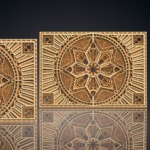
In the field of architecture and design, a prominent firm utilized layered laser cutting to create intricate decorative elements for a new commercial building project. The designers encountered obstacles with traditional methods that struggled to achieve the desired level of detail in the materials used. By employing layered laser cutting, they successfully produced highly detailed facade panels that complemented the overall architectural vision. This approach not only enhanced aesthetic appeal but also reduced installation time, demonstrating the compelling advantages of layered laser cutting in intricate design applications. These case studies collectively underscore the transformative potential of this technology across various sectors, providing tangible proof of its effectiveness in overcoming specific manufacturing challenges.
Conclusion and Takeaways
The exploration of the layered laser cutting phenomenon has illuminated its transformative potential for various industries. Layered laser cutting stands out due to its precision and versatility, making it an invaluable tool for sectors such as manufacturing, automotive, and aerospace. The technique employs focused lasers to slice through materials with remarkable accuracy, minimizing waste and enhancing efficiency. The implications of integrating this technology are profound, as it can streamline production processes while ensuring high-quality outputs.
Throughout the blog post, we’ve examined how layered laser cutting not only improves operational efficiency but also fosters innovation. The process supports the design of intricate components that are often unattainable through traditional cutting methods. Furthermore, the rapid prototyping capabilities afforded by laser cutting technology facilitate faster turnaround times from concept to production, enabling businesses to adapt swiftly to market demands.
For industries aiming to adopt layered laser cutting, it is essential to consider the initial investment in equipment and training, which can yield significant long-term benefits. Understanding various materials and their compatibility with laser cutting will also play a crucial role in maximizing the effectiveness of this technology. Companies should evaluate their specific needs and explore the customization options that layered laser cutting can offer.
As industries continue to advance, the significance of layered laser cutting will likely grow. It is a strategic asset that can be leveraged by organizations seeking to enhance their manufacturing processes and remain competitive in a rapidly evolving market. Thus, businesses are encouraged to assess the potential of incorporating layered laser cutting into their operations, taking into account both the operational efficiencies it provides and the new possibilities for product development it introduces.